STYLISTIC FEATURES OF THE PODILLIA DANCE
Oleg Popyk, Senior Lecturer in the Department of Choreography, Director of the “Vasylechky” Folk Dance Ensemble at the Khmelnytskyi Academy of Humanities and Pedagogy
Podillia dance holds a special place in Ukrainian folk choreography. Its distinctive character was shaped by the historical, social, everyday life, calendar-ritual, and cultural characteristics of the Podillia region. The region’s dance tradition reflects the character of its people, their worldview, and their attitudes toward work, nature, family, youth socialization, and festive culture.
When discussing the stylistic features of Podillia dance, it is important to view it not merely as a collection of individual dance movements. Style is shaped by a complex of artistic means of expression: the nature of the dance vocabulary, the manner of performance, body movement, hand movements, the nature of partner interaction, musical and rhythmic organization, spatial arrangement, composition, and figurative and narrative content.
It is also important to note that the traditional Podillia dance emerged in close connection with community life. Its origins are largely linked to calendar and ritual ceremonies, spring songs, hayivkas, round dances, youth evening gatherings, and various forms of leisure. It was precisely through these forms that the characteristic principles of movement, interaction among performers, and organization of the dance space gradually developed.
One of the oldest layers of Podillia’s choreographic culture consists of hayivkas and round dances. They were characterized by a variety of spatial formations: a circle, a chain, a key, two rows, a “bridge”, as well as more complex figures. In such compositions, dance movement was combined with song lyrics, playful actions, and symbolic meaning.
Well-known circle dance forms include “Kostrubonko”, “Mack (Poppy)”, “Perepilka (Quail)”, “Yashchur (Lizard)”, “Korol (King)”, “Zaichyk (Little Hare)”, “Halka (Jackdaw)”, “Ohirochky (Little Cucumbers)”, “Kryvyi Tanets (Crooked Dance)”, “Horoshok (Pea)”, “A my proso siialy (And We Sowed Millet)”, “Shum (Noise)”, “Verbova Doshchechka (Willow Plank)”, “Mosty (Bridges)”, “Bashta (Tower)” and others. Their significance lies not only in the preservation of individual dance movements but also in demonstrating the ancient principle of the syncretic combination of words, music, movement, play, and ritual action.
Subsequently, the choreographic tradition of Podillia evolved from circle-dance game forms to partner, group, and narrative dances. At the same time, the ancient principles did not disappear entirely but were transformed in accordance with new living conditions. That is why Podillia’s choreography features a combination of archaic circle dance elements with sophisticated pair and group compositions.
One of the main characteristics of the Podillia dance style is its dance vocabulary. It is characterized by a combination of simple, natural steps with technically expressive and virtuosic movements.
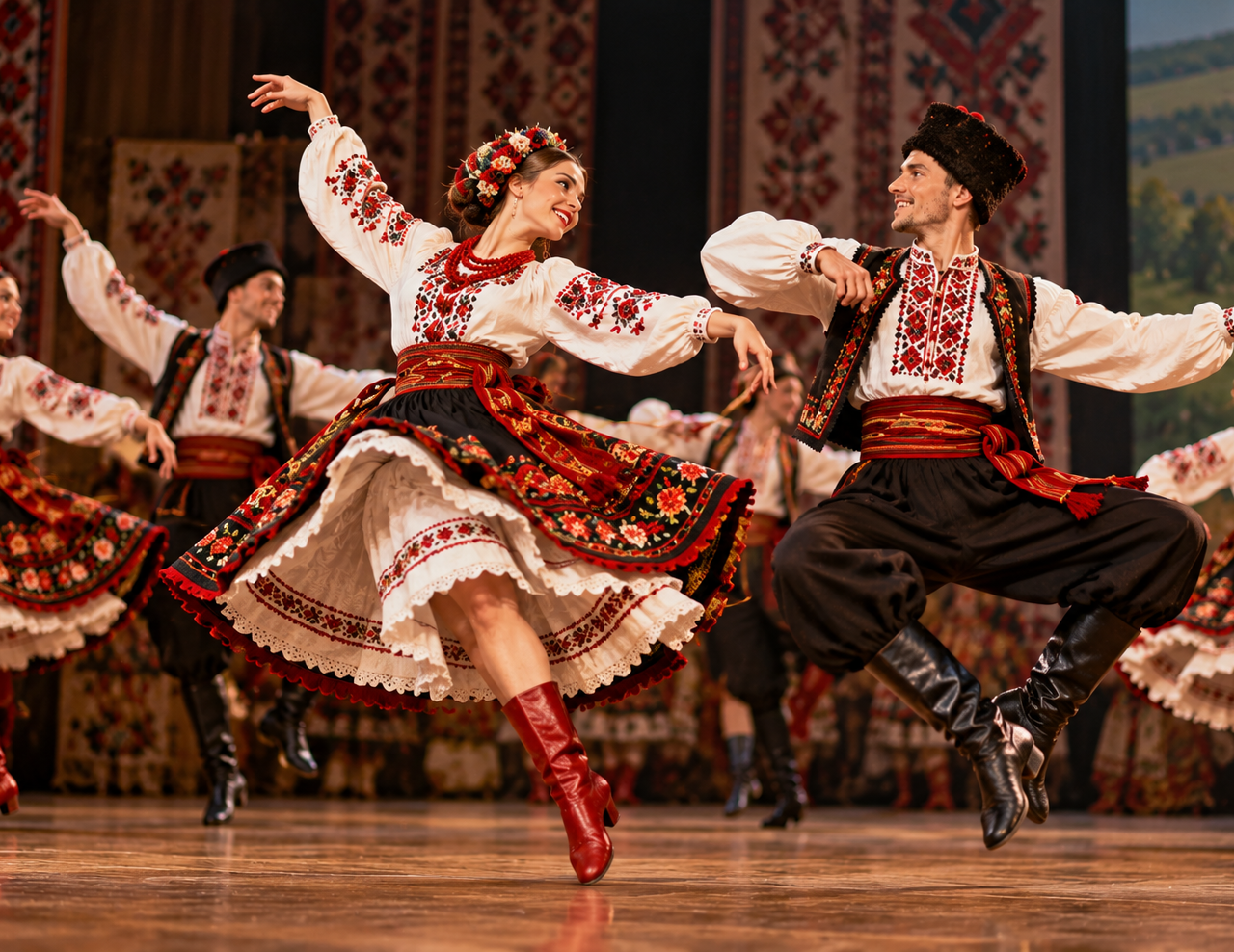
In the men’s performance, various stomps, hops, jumps, squats, turns, rising onto the toes, movements involving extending or straightening the leg, as well as complex leg combinations take on a special expressiveness. Men’s dance often showcases the performer’s strength, agility, ingenuity, and temperament.
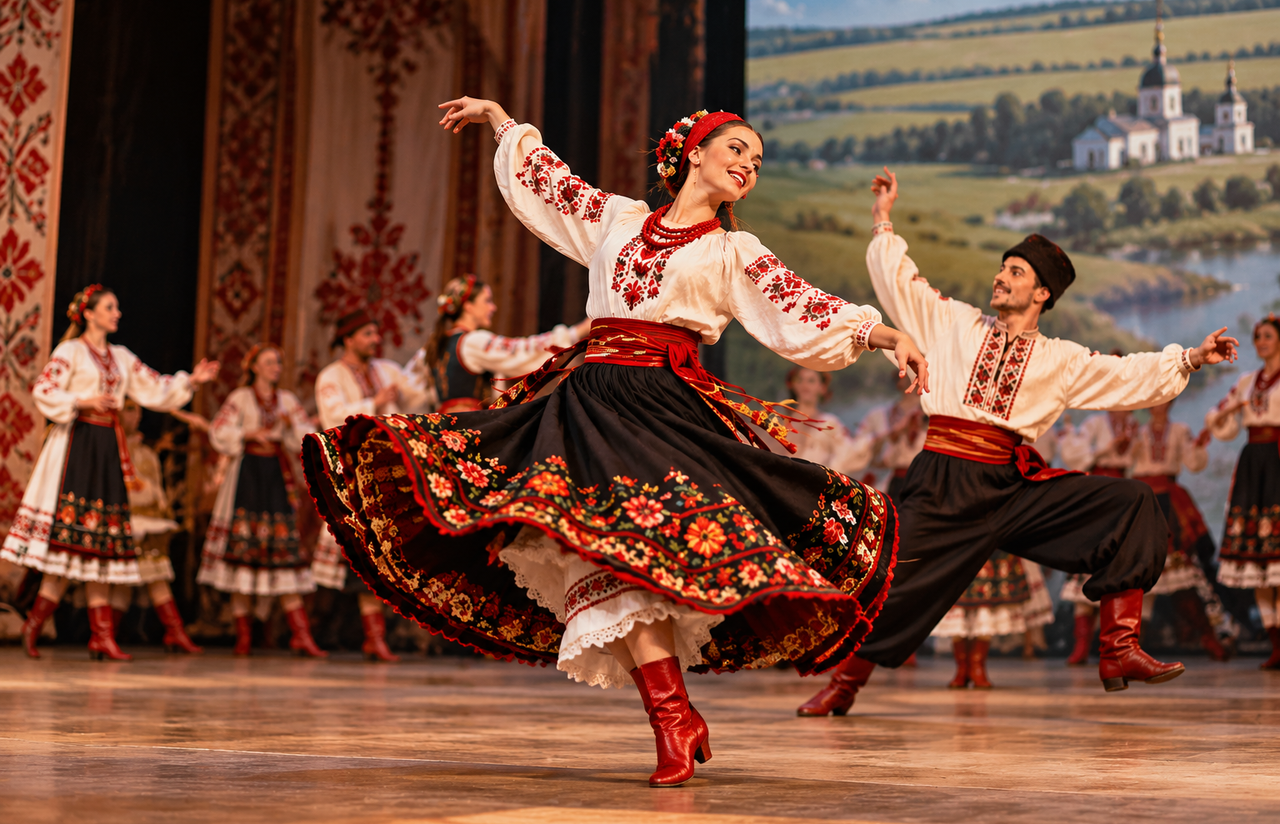
The women's vocabulary is primarily characterized by lightness, softness, and fluidity. At the same time, this does not imply passivity. The female image in Podillia dance can be lively, playful, and flirtatious, but the style of movement generally retains restraint and naturalness.
The contrast between the male and female styles of performance takes on special significance. A man may demonstrate strength, technical skill, and temperament, while a woman responds with lightness, grace, and a playful spirit. It is precisely through this interaction that the dance’s narrative often unfolds.
A prime example of this is the dance “Viz (Wagon)”, where the male and female parts have different characters. The young women perform lower, lighter jumps, while the young men demonstrate higher and more energetic movements. This contrast is not a random technical device – it characterizes the characters and enhances the playful drama of the dance.
An important component of the style is the manner of performance. Podillia dance is characterized by an organic combination of energy and inner restraint. Even in a fast dance, the movement must not lose its precision, naturalness, and inner organization.
Male performances are characterized by a confident posture, active footwork, clear accents, and dynamic changes in level. Squats, hops, and jumps are often performed with a sense of strength and showmanship.
The female style is marked by greater softness. Key elements include light weight transfer, smooth transitions, small steps, and delicate arm and torso movements.
However, the Podillia style is not limited to the “man - energetic, woman - gentle” formula. In many dances, there is an active dialogue between partners, and the dancer has the opportunity to express their individuality.
This is particularly evident in “Varvarka”. The dance is distinguished by its lively character, varied steps, tapping, balancing, and the partners’ twirling. The man’s part may include a squat with the leg straightened, which creates a contrast with his partner’s movements.
Thus, the defining feature of the Podillia style is not monotony, but contrast and dialogue in movement.
In Podillia dance, the torso generally does not exist separately from the footwork. Its position depends on the nature of the movement and the artistic intent.
In the male movements, the torso may lean forward, especially during rapid turns, jumps, and technically complex movements. This lean enhances the dynamism and creates a sense of swiftness.
This can be seen in the dance “Vykhrivka”, where the performers’ rapid spinning, forward-leaning torso, and brisk tempo create the character of a unique dance whirlwind.
In traditional dance, the hands often play a supporting role, maintaining overall coordination of movement. At the same time, in narrative dances, they can take on symbolic meaning: a gesture becomes a means of addressing someone, inviting, refusing, joking, or engaging in dialogue.
Therefore, to stylistically recreate a Podillia dance, it is not enough to mechanically repeat its steps. It is necessary to convey the manner of their execution and the nature of the whole body’s interaction.
The close connection between dance and music is another important characteristic of Podillia choreography. In the examples provided, the 2/4 time signature plays a significant role, creating a clear metrical foundation for steps, stomps, jumps, and various combinations. At the same time, the tempo and character of the performance can vary significantly.
For example, “Varvarka” is performed at a moderately fast tempo and has a lively character; “Vykhrivka” is fast, swift, and dynamic; “Podolianka”, on the other hand, is characterized by greater restraint, although it retains clarity and temperament.
Thus, an identical or similar metrical principle does not automatically determine an identical style. Of great importance are accentuation, tempo, the character of the melody, the structure of musical phrases, and the way movement is related to the musical material.
One of the most distinctive features of the Podillia dance is its narrative and playful nature.
In traditional culture, dance was often not merely movement to music, but a kind of staged performance in which the performers interacted with one another. This is especially true of dances associated with youth gatherings, everyday situations, jokes, courtship, and mutual challenges.
In such compositions, the gaze, gestures, pauses, the partner’s reaction, and changes in the direction of movement become crucial. The vocabulary of dance begins to serve a dramatic function.
A prime example is Volodymyr Hlushenkov’s choreographic composition “Vasylechki”, based on material from winter evening gatherings. In it, the characters of Vasyl and Vasylyna, courtship scenarios, jokes, dialogues, and the interaction between young people form a cohesive stage performance.
It is precisely this narrative quality that helps us understand one of the key features of Podillia choreography: movement in it often conveys imagery and meaning.
Podillia dance is distinguished by the diversity of its spatial formations. Circular and chain formations predominate in round dances. In pair and group dances, lines, diagonals, circles, counter-movements, partner crossings, turns, and rearrangements appear.
The spatial structure is directly linked to the character of the dance. In the dance “Vykhrivka”, rapid spinning creates the sensation of a whirlwind. In the dance “Varvarka”, the partners’ movements and mutual circling emphasize its playful nature. In “Viz”, the compositional organization is linked to the narrative play and the sequence of figures.
Thus, space in Podillia dance is not merely a geometric pattern. It is a means of artistic expression.
The issue of internal variability within the Podillia dance tradition deserves special attention. Podillia is a large historical and ethnographic region, so it is impossible to view all local dances as completely identical.
Even within Khmelnytskyi Region, dance styles exhibit local characteristics. This is confirmed by their names and places of origin: “Varvarka” – Bakota, “Stavchanka” – Stavchany, “Dzerzhanivska Kadril” – Dzerzhanivka, “Vykhrivka” – Vykhrivka, “Podolyanka” – Slobidka-Krasylivska.
Therefore, the concept of “Podillia style” should be understood not as a strictly defined set of identical movements, but as a set of related regional characteristics that manifest themselves in various local variations.
It is precisely this regional variability that makes the Podillia dance a living tradition. The same type of movement or compositional principle can take on different characteristics depending on the locality, musical accompaniment, function of the dance, and performance style.
The issue of stylistics takes on particular significance in the process of staging folk dance.
When traditional material is adapted for the stage, it undergoes reorganization: the number of performers increases, the composition becomes more complex, the spatial pattern expands, the dramatic effect is heightened, and the musical form and duration may change.
However, stage adaptation must not destroy the fundamental stylistic features of the original source.
The greatest danger lies in the mechanical use of individual “characteristic” movements without preserving the manner in which they are performed. For example, the “prysiadka” (squat) alone does not make a dance a Podillia dance. What matters are its character, musical accentuation, relationship to other movements, interaction with a partner, and the overall choreographic organization of the composition.
Therefore, in a stage reconstruction, it is necessary to preserve not only the vocabulary but also the way of thinking inherent in traditional dance: its character, imagery, interaction among performers, musical-rhythmic structure, and regional distinctiveness.
Contemporary research and cultural projects in the Khmelnytskyi region also emphasize the need not merely to reproduce movements, but to preserve the character and tradition of Podillia dance. In contemporary research, stylistics is examined in relation to regional vocabulary, the semantics of movements, stage interpretations, and issues of preserving the choreographic heritage.
Thus, summarizing the material, we can identify several interrelated characteristics of the Podillia dance style.
First, there is a distinct and varied dance vocabulary that combines simple steps, stomps, hops, turns, and squats.
Second, the contrast between male and female styles. Male performances tend toward strength, dynamism, and technical showmanship, while female performances tend toward lightness, softness, fluidity, and playful expressiveness.
Third, dynamism and contrast. Within a single dance, the tempo, character, direction of movement, levels, and modes of interaction among the performers can vary.
Fourth, the playful and narrative elements. The dance action is often structured as a dialogue between partners or groups.
Fifth, a close connection to the music. Movement is organized in accordance with the rhythmic structure, musical phrases, accents, and character of the melody.
Sixth, a variety of spatial formations – ranging from circles and chains to paired, line, diagonal, and more complex compositional forms.
Seventh, regional variation, which does not negate the integrity of the Podillia style but, on the contrary, demonstrates its inherent richness.
And finally, an important characteristic is the organic and natural quality of the performance. A Podillia dance should not look artificial. Even a technically complex movement must remain an organic part of the whole picture.
Conclusion
Thus, the stylistic features of the Podillia dance have evolved as a result of the long-standing development of the regional choreographic tradition and reflect the historical experience, way of life, worldview, and artistic sensibilities of the people of Podillia.
Podillia dance is not merely a set of characteristic movements. Its style is defined by a complex of interrelated features: vocabulary, manner of performance, body movement, hand movements, the specific performance styles of men and women, musical and rhythmic organization, spatial composition, narrative elements, and a playful nature.
The interaction between traditional and stage elements takes on particular significance. Folk-stage dance can develop and creatively reinterpret folkloric material; however, its artistic persuasiveness depends to a large extent on how deeply the regional stylistics have been preserved.
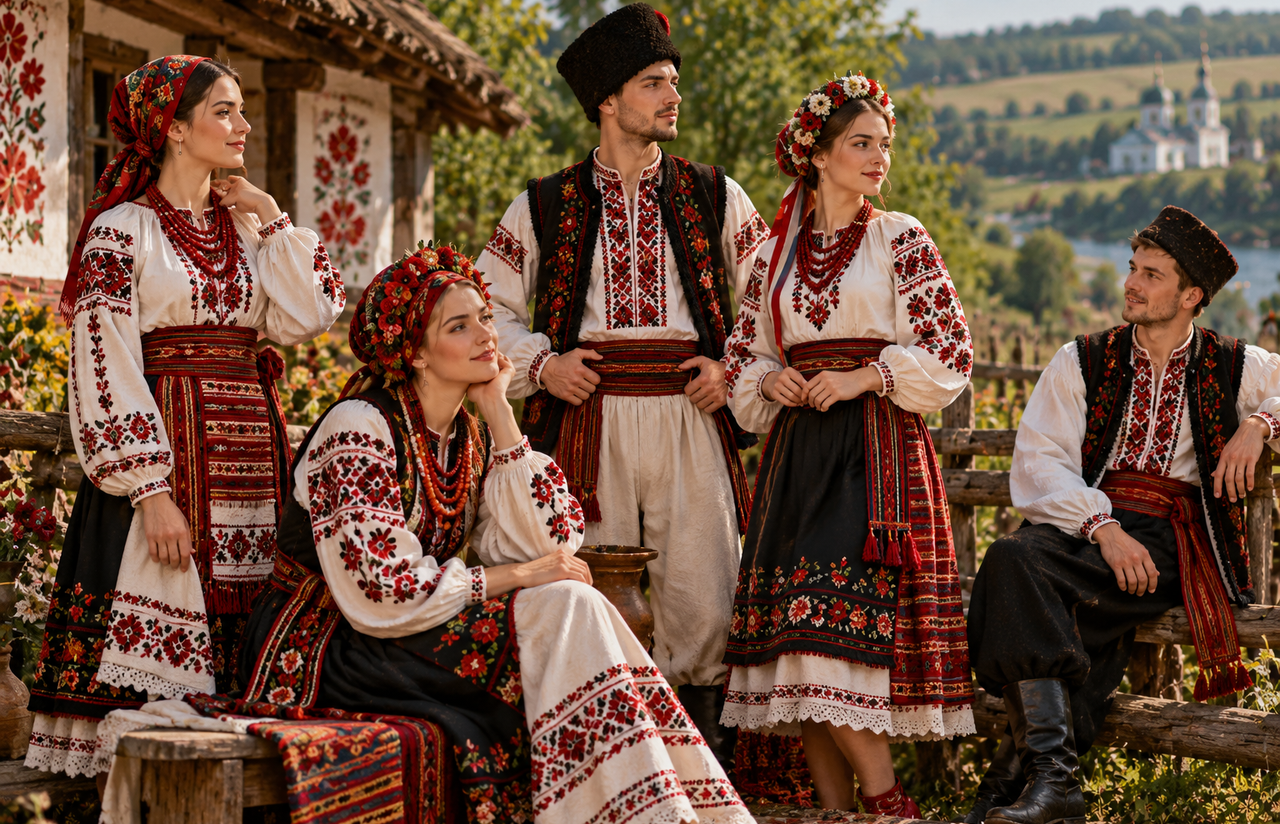
That is why, when studying, reconstructing, and adapting Podillia dances for the stage, it is necessary to refer not only to dance vocabulary but also to primary sources—folklore recordings, musical material, descriptions of local traditions, testimonies from practitioners, costume features, and local performance styles.
In this context, the stylistic code of Podillia dance can be defined as the unity of movement, character, music, space, image, and tradition. It is precisely this combination that shapes the recognizable artistic distinctiveness of Podillia choreography and ensures its preservation and further development in contemporary folk stage art.