
Фонограма танцю
Viz
- Походження:
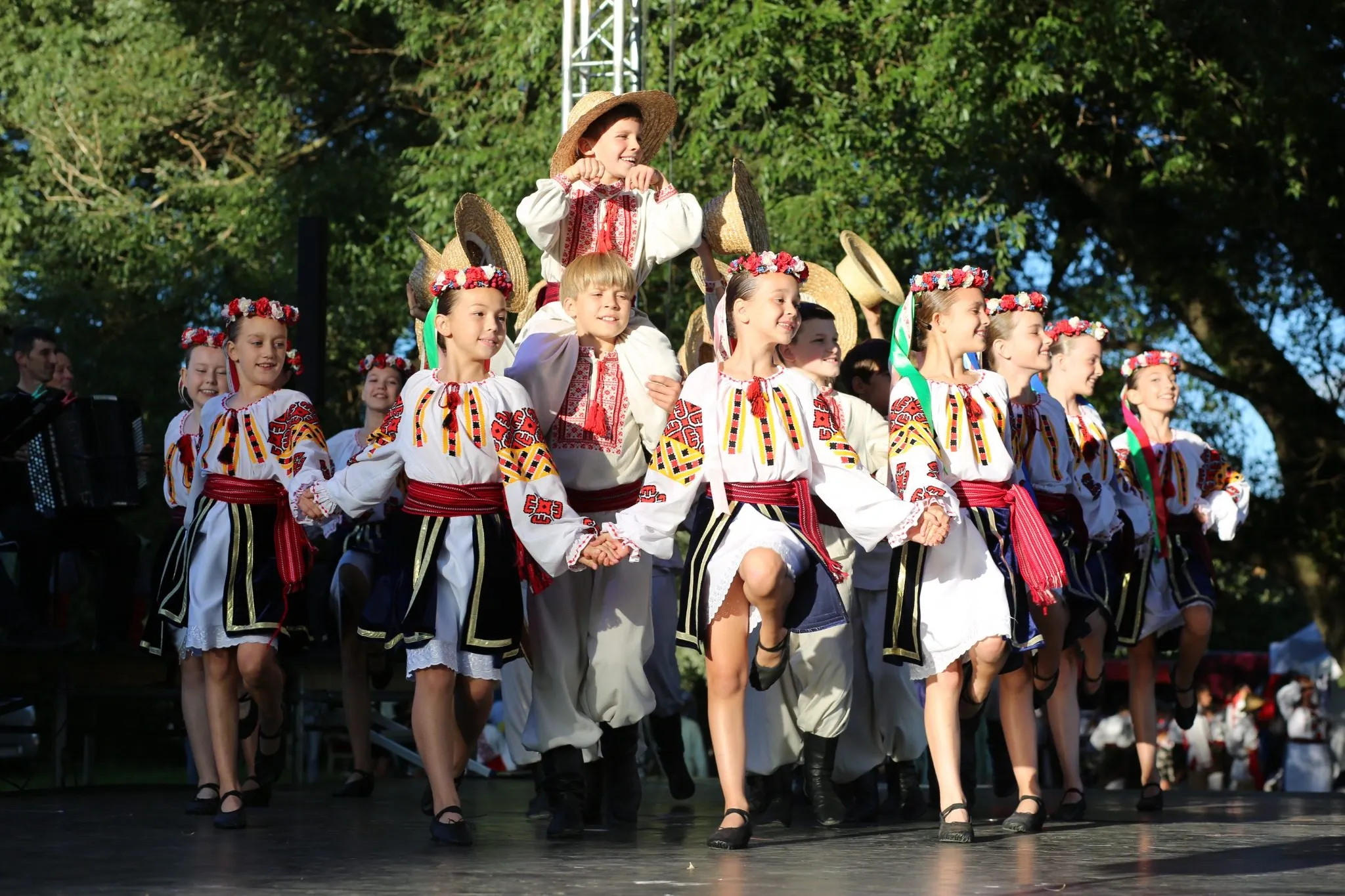
- Tarasivka village, Kamianets-Podilskyi district, Khmelnytskyi region
- Хореографія:
- staged by Oleksandr Nebesnyi; restored by Serhii Pedan
- Виконує:
- Dzherelo ensemble
The "Viz" dance comes from Bakota, an ancient town on the Dniester flooded by a reservoir in the 1980s. It used to be performed by young men at evening parties in a round dance, with a leader holding a real cartwheel to set the pace for all the rows.
The name is linked to the cart riders' ritual: on St George's day the boys drove girls around the village on a cart, and in winter the same movements were recreated without a cart, only with singing and a fiddler. The dance was recorded in 1982 from residents of the flooded village who had moved to Velyka Bubnivka.
Today "Viz" has become a symbol of memory for Bakota — it is performed at festivals in Kamianets-Podilskyi and Khmelnytskyi, and every performance begins with words about the flooded homeland.
Опис проєкту
DANCE DESCRIPTION: “Viz” (Cart)
Choreography - Volodymyr Titov
Recreation - Olena and Volodymyr Dolchuk
Arrangement - Ihor Pokhodoshchuk
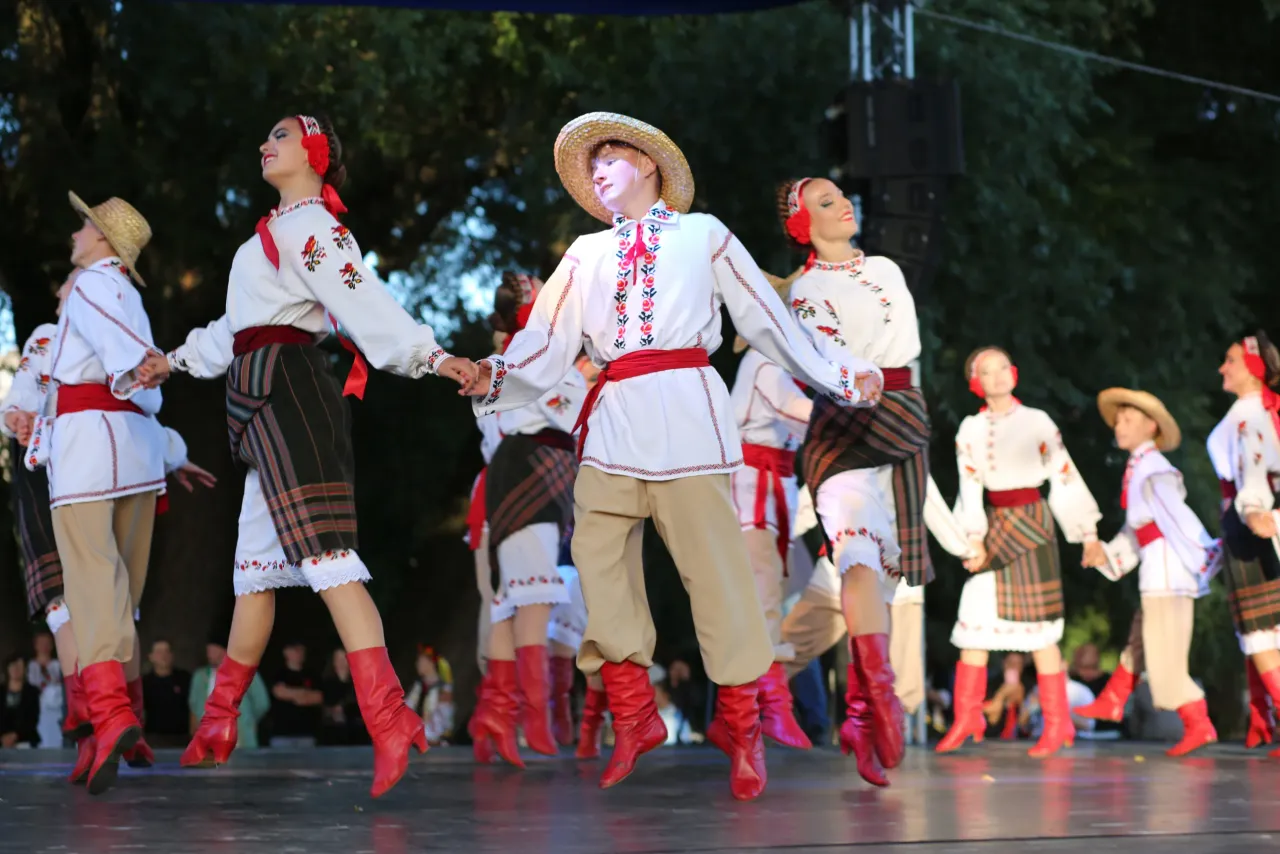
Performed by the “Barvinok” Folk Dance Ensemble of the Borshchahivka School of Arts (Sofiivska Borshchahivka village, Bucha District, Kyiv Region) under the direction of Olena and Volodymyr Dolchuk.
Duration: 3:37 min.
Background: In 1936, Volodymyr Titov had the good fortune to meet the renowned Ukrainian choreographer and art historian Vasyl Verkhovynets. When the conversation turned to Podillia choreography, Verkhovynets told V. Titov that it was in Podillia where he had discovered an interesting narrative dance. The performers of this dance imitated riding in a cart: the movements of horses and wheels, and so on. Later, in 1949, in the village of Velyka Bubnivka in the Chornoostrivskyi District (now the Khmelnytskyi District), Volodymyr Titov learned from the villagers about a humorous dance that had once been performed there, in which the girls portrayed the cart itself and the boys portrayed the drivers. Thus, based on the collected material, choreographer V. Titov created the Podillia folk stage dance «Viz», which was included in the 1951 collection «Dances of the Peoples of the USSR» and was subsequently reprinted many times in various collections in Ukraine.
Description of the dance:
Composition and notation of the dance by V. Titov
Twelve young women and six young men participate in the dance. The number of performers may be increased or decreased.
Before the dance begins, all performers line up behind the right-hand back curtain as follows: the young women, holding hands, form an elongated semicircle - a “horseshoe” - representing a “cart.” The young men stand inside the “cart” (horseshoe) in two rows, representing the “drivers.” A musical introduction of four measures of musical accompaniment is performed.
First Figure (16 measures)
The 1-st and 2 nd measures of the musical accompaniment are performed
Measures 1-16: The young women, holding hands and maintaining the horseshoe shape, move in a circle counterclockwise, as shown in Fig. 1, using the Podillia alternating step; the young men move in the same direction, performing the “pa-de-bask.” They hold a hat in their right hand, raised upward, while their left hand rests on their waist. On the 16th measure, the dancers step to the center of the stage; the girls unclasp their hands, and the boys place their hats on their heads.
Second Figure (8 measures)
The 1st measure of the musical accompaniment is performed
The young women spread their arms out to the sides at waist level, palms facing upward. Those on the right side hold their left hands in front of their bodies and their right hands slightly behind; those on the left side of the stage hold their right hands in front of their bodies and their left hands behind.
Measures 1-8: The young women move in a running step to the left and right in two equal rows, as shown in Fig. 2, and line up in a single row facing the audience.
At the same time, the young men, divided into two equal rows, move in a running step as shown in Fig. 2, and, forming a single row, stop in front of the young women, also facing the audience (Fig. 3).
Third Figure (8 measures)
The 2nd measure of the musical accompaniment is performed
Measures 1-2: The young men perform two simple heel steps, starting with the right foot: on the “one” of the first measure, a heel step; on the “two,” energetically step down on the entire foot, with body weight on the right leg, arms open in second position, palms facing the audience; on the second measure, this movement is repeated starting with the left leg.
Measures 3-4: The dancers perform four “jetés” backward, starting with the right foot and moving toward the front of the stage, arms lowered and drawn slightly backward.
Measures 5-6: The dancers perform two side prysiadkas (squat-kick) from the right and left feet. Arms are open in second position.
Measures 7-8: The young men perform a “tombe” with the leg extended forward, starting with the left foot. At the end of the 8th measure, the left arm is raised to the third lowered position, and the right to the second. At the same time, the young women perform two “pas de basque” in place, starting with the right foot. The arms are open at hip level, holding the ends of the ribbons. Measures 3-4: the young women perform four “jetés” backward in place, starting with the right foot. Hands on the waist. Measures 5-8: the young women perform the previous movements from measures 1-4 of this figure.
Fourth Figure (16 beats)
The 1st and 2nd measures of the musical accompaniment are played
Measures 1-4: The young men perform the “ball” movement, which is executed as follows: on the “one” of the first measure, they squat on the balls of both feet, heels together, knees turned outward. On “two”—take a small hop on the balls of the feet. These hops continue at a rate of two per measure of the musical accompaniment. While performing this movement, the left hand rests on the waist, and the right hand is raised upward, mimicking the swinging of a whip as if urging the horses on.
Measures 5-6: The young men perform two side squats, starting with the right and then the left leg.
Measure 7: A Podillia-style squat is performed starting with the right leg. The arms are open in second position, palms facing upward.
Measure 8: A triple tuck is performed. Hands on the waist. At the same time, on measures 1-3, the young women perform three side “pa-de-bure” steps in place, starting with the right foot - hands open in second position. Measure 4: The young women perform a triple stomp, starting with the left foot, hands on the waist. Measures 5-8: The young women perform a simple dribushka twice with a tap, hands on the waist.
Measures 9-16: All dancers repeat the movements of measures 1-8 of this figure.
Fifth Figure (8 measures)
The 5th measure of the musical accompaniment is played
Measures 1-4: The young women move forward in pairs, performing an alternating step, and line up as shown in Fig. 4. At the same time, the young men, divided into two equal groups, also move toward the right and left wings using an alternating step, as shown in Fig. 4.
Measures 5-8: The young women in each pair take each other by the right hand, with their left hands on their waists; leaning their upper bodies slightly to the left and pressing against one another, they circle in place clockwise, performing an alternating step. At the same time, the young men continue to move forward (Fig. 5).
At the end of the 8th measure, the young women lower their arms and stop, each at her starting position with her side facing the audience; the young men turn to face the young women (Fig. 6).
Sixth Figure (16 measures)
The 3d and 4th measures of the musical accompaniment are performed
Measures 1-2: The young women perform a double “holubets” with a stomp, starting with the right foot. The young women move apart in different directions. On the 1st measure of the musical accompaniment, the arms open to second position; on the second measure, they are placed on the waist.
Measures 3-4: The young women perform the same movements, moving to the left, starting with the left foot.
Measures 5-6: The young women switch places, performing an alternating step, passing each other on the left side while turning 180° clockwise.
Measures 7-8: The young women perform a “kolupalochka” with a stomp. Those standing to the left of the audience perform it starting with the right foot, while those standing to the right start with the left. Hands on the waist.
At the same time, on measures 1-2, the young men perform two side squat - those standing on the left start with their right foot, and those on the right with their left. Hands are open in second position. Measures 3-4: The young men perform a squat with a hand strike on the floor. The young men standing on the left, on the off-beat “and” of the third measure, make a small hop on their left leg, while bringing their right leg - with the knee bent and drawn to the side - up to the ankle of their left leg behind it; arms are lowered. On “one,” from the hop, lower into a squat on the left leg; straighten the right leg at the knee and bring it back, leaning the torso forward. The right arm traces a circle from below, back, and up, as if swinging a whip. On “two,” strike the floor with the palm of the right hand. 4th beat: Straighten the torso and perform a triple stomp, hands on the waist. The young men standing on the right perform the same movements, but using the opposite legs and arms. Measures 5-7: The young men perform three “pa-de-baska,” starting with the right leg—arms open in second position. 8th measure: The young men perform a triple stomp, hands on their waists.
Measures 9-16: The movements from measures 1-8 of this figure are repeated. At the end of the 16th measure, the young women turn to face the audience (Fig. 7).
Seventh figure (8 measures)
The 3d figure of the musical accompaniment is performed
Measures 1-4: The young women join hands, crossing them (right hand over left). Standing in place, they perform a “balance,” starting with the right foot. While performing this movement, they tilt their heads first to the right and then to the left, at first gently, then more energetically, as if horses were galloping with excitement (Fig. 7).
Measures 5-7: The young women perform a double tap three times, starting with the right foot, then the left.
Measure 8: The young women separate their arms, move apart into two columns facing each other, and perform a triple stomp (Fig. 8).
At the same time, the young men perform two “pa-de-basque” on measures 1-2, starting with the right foot - arms open in second position. Measure 3: The young men perform two “jete” backward with claps from the right and left feet. Measure 4: A triple stomp is performed with a turn with the back to the audience - hands on the waist (Fig. 8). Measures 5-8: The young men perform an alternating step, moving forward as indicated by the dotted line in Fig. 8.
Eighth Figure (8 measures)
The 4th measure of the musical accompaniment is performed
Measures 1-4: The young women place their hands on their waists and perform a “balance,” repeating the movements of measures 1–4 of the seventh figure. The young women standing on the left begin the movement with their right foot—their heads tilt to the right. The young women standing on the right begin the movement with their left foot, and their heads tilt to the left.
Measures 5-6: The young women perform a double tap twice, first with the right foot and then with the left. Their heads remain as in the previous movements of measures 1-2. At the same time, on measures 1-4, the young men take alternating steps to position themselves between their partners, as shown in Fig. 9.
Measures 5-6: The young men squat on their toes and perform the “ball” movement, just as in measures 1-4 of the fourth figure.
Measures 7-8: The young women line up in two circles, joining hands with one another. At the same time, the young men enter the center of the circles, join their right hands in the center of the circle, and place their left hands on their partners’ joined hands, creating the appearance of two wheels (Fig. 10).
Ninth Figure (8 measures)
The 2nd figure of the musical accompaniment is performed
All dancers perform an alternating step in circles, moving clockwise. On the 8th measure, the dancers form trios again, as shown in Fig. 11.
Tenth Figure (8 measures)
The 2nd measure of the musical accompaniment is performed.
Measures 1-7: The dancers in trios perform an alternating step, moving diagonally. On the 8th measure, they turn to the right, line up as shown in Fig. 12, and perform a triple stomp.
Eleventh Figure (24 measures)
The 1st, 2nd, and 5th measures of the musical accompaniment are performed
The dancers in each trio, taking turns every 2 measures of the musical accompaniment, step into the starting position in front of the other dancers, who are lined up diagonally and performing a solo; moving diagonally toward the first left wing. The remaining dancers in the trios move diagonally toward the third right wing, performing half-turns until it is their turn to step out for a solo (Fig. 13).
Measures 1-2: The dancers of the fourth trio assume their starting position as follows: the young man stands with his back to the other dancers lined up diagonally, his left hand on his waist and his right hand in the third lowered position.
The young women - his partners - face their partners, holding the ends of the ribbons.
Measures 3-8: The young man from the fourth trio moves diagonally, performing a side squat only from the left leg, while his partners follow him, performing a “pas de basque” (Fig. 12). Measures 3-4: Trio 5 returns to the starting position and assumes the “taka i yuzu” formation: the young women stand side by side, with their backs to the direction of movement - their hands holding the ends of the ribbons. The young man faces the young women, his right hand raised as if holding a whip, his left hand on his waist.
Measures 5-10: The young women move diagonally, performing the “rope dance”; the young man of this trio follows the young women, performing an energetic “pa-de-basque” with a high jump. With his right hand, he mimics the motion of swinging a whip. Measures 5-6: The sixth trio takes their starting position and assumes the following pose: the young women in this trio stand as the young women in the fifth trio do, but the young woman on the right offers her left hand to the young man, and the young woman on the left offers her right; their free hands hold the ends of the ribbons. At the same time, the young man crouches on his toes, knees together, and offers his hands to his partners.
Measures 7-12: This trio moves diagonally as follows: the young women perform an alternating step backward, while the young man performs a “slide” - on the “one” of each measure, he thrusts his right leg forward, knee straight, toe extended. On “two,” the right leg comes down to the floor, the body’s weight shifts onto it, while the left leg is thrust forward in the same way as the right leg on “one.” On the remaining measures, the movement is repeated while moving diagonally.
Measures 7-8: The first trio returns to the starting position and assumes the following formation: the young woman standing to the left of the young man takes the lead, followed by the young man, then the second young woman; all face the audience. Measures 9-14: Both young women, moving diagonally, perform a “shene” - that is, full turns clockwise every quarter measure - while the young man performs a side lunge from his left leg, just as the young man from the fourth trio did.
Measures 9-10: Trio 2 returns to the starting position and stands as follows: the girls stand side by side with their backs to the direction of movement - arms relaxed; the young man faces the young women, arms open in second position.
Measures 11-12: The young women perform the following: on “one” of the 11th measure, they cross their left leg over their right; on “two,” they perform a “holubets” with their right leg, turning 90° clockwise in the direction of movement. On “one” of the 12th measure, this movement is repeated, but with the opposite legs. By the end of the 12th measure, the young women are facing away from the young man. They hold the ends of the ribbons with their hands at all times.
Measures 13-14: The young women move diagonally, performing an alternating step.
Measures 15-16: The young women repeat the movements of measures 11-12 of this figure, but by the end of measure 16, they are facing the young man, while the young man follows the young women, performing two “pa-de-basque” on beats 11-12, starting with the right foot, arms open in second position.
Measures 13-14: the young man performs four “jetés” backward, hands on his waist, measures 15-16 – the young man repeats the movements of measures 11-12 of this figure.
Measures 11-12: The last trio returns to the starting position and assumes the same pose as trio 6 did on measures 5-6.
Measures 13-18: This trio performs the same movements as Trio 6 in measures 7–12 (Fig. 13). When the last trio finishes its solo, the dancers immediately assume the position shown in Fig. 14.
The young man stands in the center, with his partners on either side. The young woman standing to the young man’s left offers her left hand to him and places her right hand on his left shoulder. The young woman standing on the right offers her right hand to the young man, which he holds with his right hand, while she places her left hand on his right shoulder. The trios move in a circle, as shown in Fig. 14, until the end of the 24th measure, at which point the dancers form the “viz" ("cart”) figure (Fig. 15). In the 11th figure, the dancers mimic a road along which horses and their drivers are galloping.
At the discretion of the dance troupe’s director, who will include the “Viz” dance in the performance, the solo elements of the dance may be replaced with others, depending on the troupe’s technical proficiency. Here, the young men can perform tricks such as the “barrel,” “goat,” “bedouin,” “pike,” “ring,” and so on. Similarly, the young women’s movements can be made more challenging.
Twelfth Figure (8 measures)
The 6th measure of the musical accompaniment is performed
Measures 1-8: The “viz,” which has been assembled, moves across the foreground of the stage in a clockwise circle and “drives off” behind the third right wing of the stage (Fig. 15).
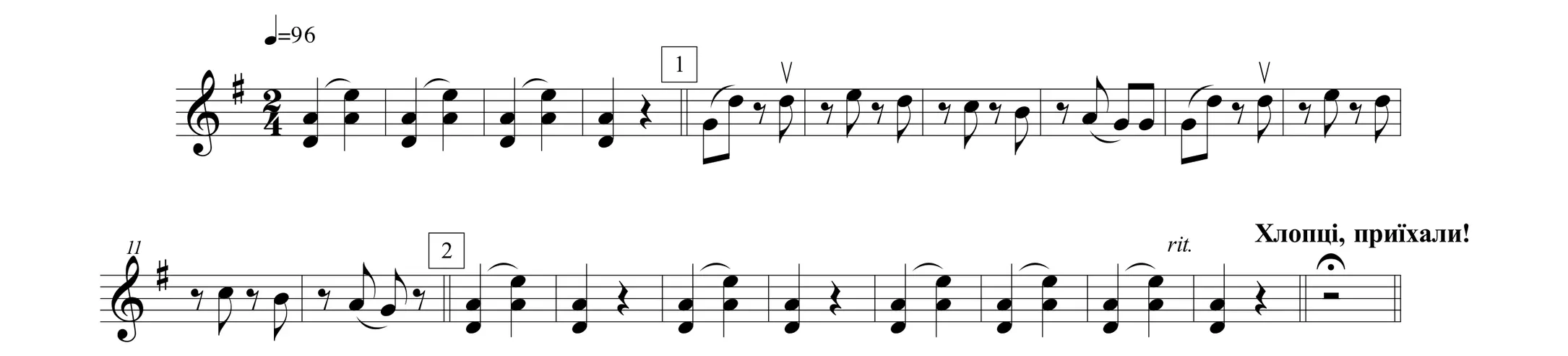
Аудіопрогравач із фонограмою
Прослухайте фонограму танцю. Використовуйте її для навчання або виступів.
Музичний супровід
Навчайтеся танцювати разом з нами!
Покрокові відеоуроки допоможуть вам опанувати рухи подільських танців
Перейти до вивчення танцю